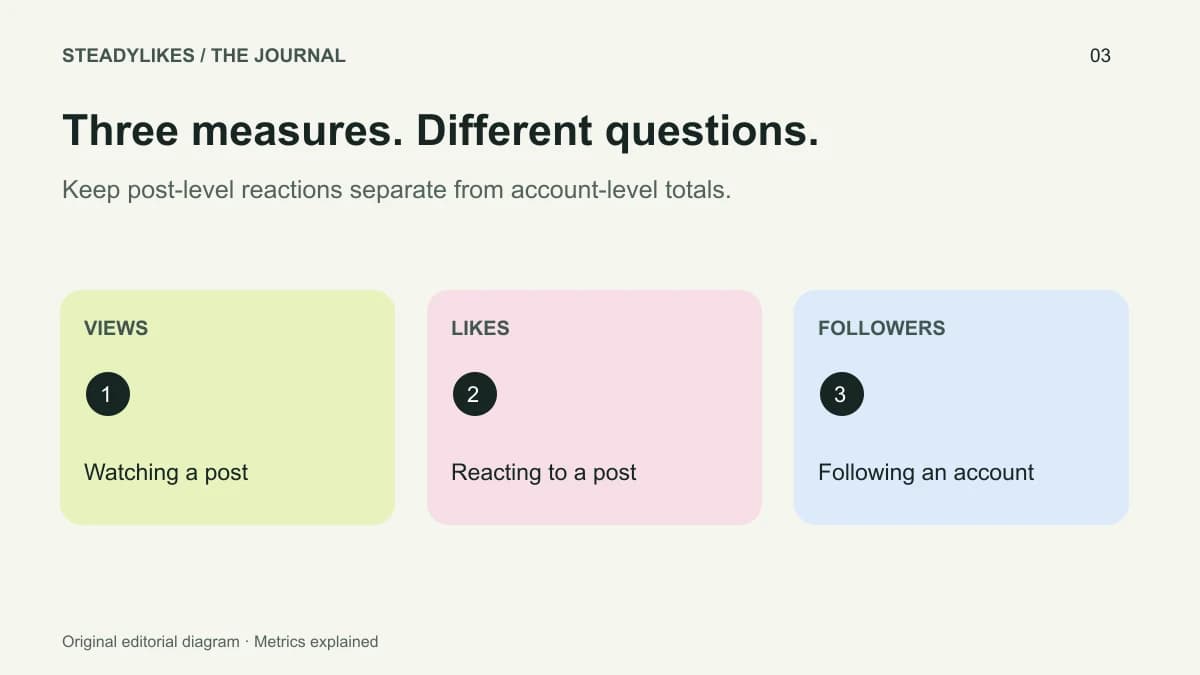
TikTok views, likes and followers describe different things. Views relate to watching a post, likes record a reaction to a post, and followers connect an account to an ongoing audience relationship. Looking at one number alone cannot tell you whether a video explained its topic well, whether someone visited the profile or whether a business received an enquiry.
Start with the decision you want to make, then choose the relevant measure. This guide separates those decisions with practical examples and a simple worksheet for recording what happened.
Three numbers, three questions
| Measure | Main level | Useful question | What it does not establish on its own |
|---|---|---|---|
| Views | Post | How much viewing activity does this post show? | Unique people, purchase intent or sales |
| Likes | Post | How many positive reactions does this post show? | Why each person reacted or whether they followed |
| Followers | Account | How many accounts are connected as followers? | How many watched a particular post |
Use the metric labels and definitions available in your own analytics when recording detailed results. Do not silently substitute views for unique viewers or treat a visible count as a complete record of audience behaviour.
Views help you ask about a particular post
Suppose you publish a short demonstration of packing a ceramic mug for shipping. The view count belongs to that upload. It does not automatically describe the reach of your whole account, and it should not be copied into a report as a customer count.
If your question is whether the demonstration is easy to follow, pair the viewing information with what the video actually shows. Look for missing steps, confusing transitions and questions in the responses. A number can direct your attention, but the video and its context help you decide what to change.
When comparing uploads, record their ages. A post that has been available for two weeks and one published this morning have had different observation windows. Treating those counts as directly comparable can create a misleading conclusion before you have even looked at the content.
Likes describe a response to the post
A like can be relevant when you are reviewing how people react to an individual video. It is still only one kind of response. A practical explanation may generate a specific follow-up question, while an attractive finished-object shot may invite a simpler reaction.
Consider two illustrative mug videos. One shows the finished glaze; the other demonstrates how to clean a tool. If their likes differ, that does not prove one topic is universally better. They serve different purposes, and the viewers who encountered them may differ too.
If you calculate a like-to-view ratio for your own worksheet, label the formula explicitly: likes divided by views, multiplied by 100. For example, 40 likes divided by 1,000 views equals 4%. These are invented arithmetic inputs, not an industry benchmark or an expected result. Do not label this narrow ratio a complete engagement rate without explaining what it includes.
Followers belong to the account
A follower count is an account-level figure. The practical content question is whether a visitor can understand what the account will continue to publish. A clear profile theme and a recognisable body of work help you communicate that expectation.
Account growth and post performance should therefore have separate rows in your notes. A video can receive attention without establishing a consistent reason to return to the profile. Conversely, a useful series can be part of a longer relationship even when one instalment is quieter than another.
When comparing TikTok follower packages, the destination is the profile. Likes packages and views packages use an individual video. These service categories follow different destinations and should not be treated as interchangeable selections.
A worksheet that keeps the context visible
Record the post URL, topic, format, publication date, observation date and the metrics relevant to your question. Add a short note explaining any paid promotion, service activity, collaboration or other change during the period. This helps you avoid attributing all movement to a new opening or caption.
Use a separate account row for follower totals and profile changes. If you update the bio at the same time as launching a series, note both. Your record should make uncertainty visible rather than pretending that one change explains everything.
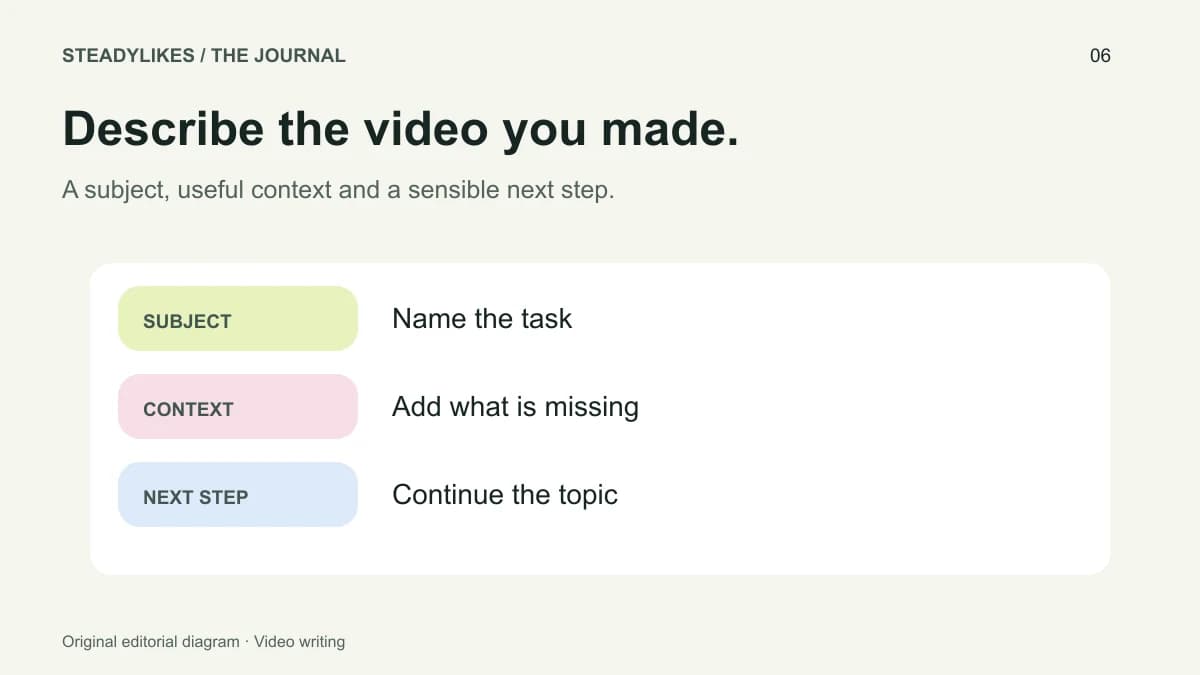
The posting checklist can provide a consistent description of what changed between videos. Keeping the correct post link in the same record prevents a report from mixing similarly named uploads.
Frequently asked questions
Are views the same as people?
Do not assume they are. Use a metric explicitly labelled as viewers or unique viewers when that is the question, and consult the definition available in your analytics.
Can I compare likes on two videos?
Yes, as a descriptive comparison. Record comparable observation windows and account for differences in topic, audience, format and any additional activity before drawing conclusions.
Which metric should I focus on first?
Choose it from your goal. A post review may start with viewing and response information; an account review may focus on profile clarity and follower change. A sales question needs actual sales or enquiry records as well.
Will a particular ratio guarantee more distribution?
This guide does not provide a distribution threshold. Ratios are tools for describing observations, not promises about what TikTok will do next.